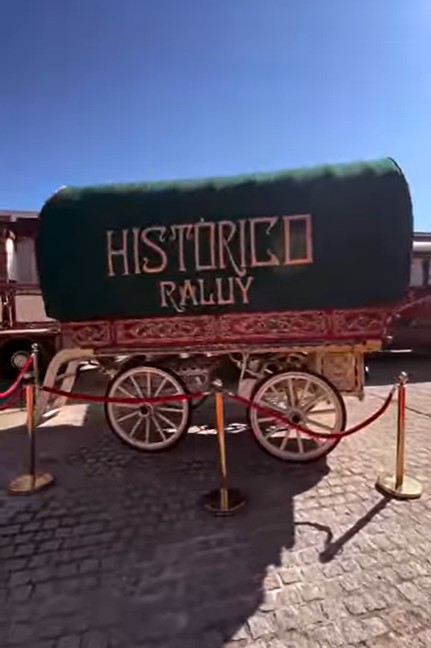
At the end of the 19th century, when Europe was experiencing the accelerated pulse of industrialization but still breathed the romanticism of dirt roads, one of the most beautiful and functional pieces of British itinerant culture emerged: the Romani Vardo of the Reading type.
Far from being a simple wagon, this vehicle represented a true mobile home, a symbol of identity, and a declaration of artisanal pride. Today, original examples of this English Gypsy caravan are part of historical collections such as that of the Raluy Historical Circus , where they are preserved and restored as authentic vintage wagons that keep alive the memory of the circus and European itinerant life.
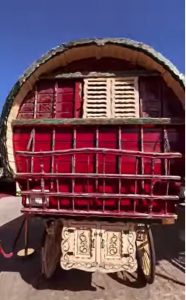
English Gypsy caravan, Reading type: a house on wheels
The Reading model, developed in the English region of Berkshire around 1870, reached its aesthetic peak in the 1890s. It was distinguished by its raised chassis, straight sides, and a characteristic curved, domed roof. The large, spoked wheels, of considerable diameter, allowed it to travel on muddy tracks and uneven terrain, common in rural England at the time.
The central rear door, preceded by small removable steps, led to a surprisingly sophisticated interior. On either side, small decorated windows let in natural light. The exterior ornamentation was one of its most striking features: panels painted in vibrant colors—greens, reds, and yellows—combined with carved moldings and gilded details that made each unit a unique piece.
Not all vardos were created equal. Compared to lighter models like the Bow-top, covered with an arched canvas, the Reading was considered a more solid, structured, and prestigious version. It was, in a way, the " luxury model " among British Romani wagons.
Function and everyday life
The Romani Vardo, of the Reading type, was not merely a means of transport. It was a family's complete home. Inside, it incorporated benches that transformed into beds, small built-in wardrobes, hidden drawers, and shelves for utensils. Although cooking was usually done outside, the cart housed everything necessary for daily life.
Nineteenth-century British Romani communities engaged in a wide range of professional activities: street vending, horsemanship, blacksmithing, music, and participation in seasonal fairs. The vardo allowed them to keep pace with these activities, moving according to job opportunities and the agricultural seasons.
In addition to its practical function, the wagon played a significant social role. Its rich decoration reflected the economic status and reputation of the owning family. The more elaborate the design, the greater the prestige within the community. It was not uncommon for the ornamentation to convey family pride and generational continuity.
Historical context and evolution
By 1896, the Reading wagon was experiencing its golden age. Improvements in wheel manufacturing and industrial carpentry allowed for stronger structures. Paints and varnishes offered greater durability, while craftsmanship remained a central element of the construction process.
Mass motorization had not yet arrived, so these vehicles relied entirely on animal traction. Horses were an essential part of the whole, not only as a pulling force, but also as a valuable family asset.
With the advance of the 20th century and the transformation of transportation, the functional use of the vardo diminished. However, its aesthetic legacy endured, and it became a romantic icon of European nomadic life.
Influence in the world of entertainment and the circus
The visual imagery of the Romani vardo of the Reading type maintains a direct relationship with the iconography of traveling shows. Itinerant fairs, variety artists, and early popular entertainments shared this same mobility and intense decorative aesthetic.
The transition to European circus wagons inherited part of that tradition: vehicles painted in vibrant colors, ornate typography, and a conception of transport as a scenographic element. The wagon was not only a logistical means; it was also an artistic calling card.
In this sense, the vardo can be considered one of the cultural and visual antecedents of the great circus convoys that, decades later, would travel across Europe transporting illusions, animals and artists.
The circus is a vintage experience because it keeps alive a form of entertainment linked to travel, wagons, and the thrill of discovering unique worlds under a big top. In pieces like this English gypsy caravan, reminiscent of Reading, that itinerant memory takes on a special presence, reminding us that the classic circus is not only viewed, but experienced as a fragment of history in motion.
The gypsy caravan, much more than a vehicle
The Vardo Reading, dating from the late 19th century, synthesizes architecture, craftsmanship, mobility, and culture. It represents a way of life based on freedom of movement and family self-sufficiency. It served as a dwelling, a symbol of Romani identity, and simultaneously a professional tool and a work of art.
Its tall silhouette and curved roof still evoke a time when the road was home and the horizon, the destination.
The vintage wagons of the Raluy Historic Circus: restoring history on wheels
In the world of the classic circus, wagons are not mere decorative elements, but authentic pieces of artistic and cultural heritage. In the case of the Circo Raluy Histórico, the restoration of antique wagons is an essential part of its identity and its commitment to the memory of the European circus.
The Raluy family has dedicated decades to restoring and preserving historic vehicles, many of them from former European companies. This work goes far beyond mere structural repairs: it involves meticulous restoration that respects original materials, artisanal techniques, and decorative finishes characteristic of each era. Fine woods, antique hardware, carved moldings, and ornamental paintwork are carefully restored to return each piece to its original splendor.
Restoration requires patience, technical expertise, and historical sensitivity. Each wagon has a story behind it: artists who lived inside, tours to different countries, and golden ages of the traditional circus. By bringing them back to life, the Raluy Historical Circus not only preserves objects but also stories and emotions linked to generations of traveling artists.
Thanks to this approach, the audience not only attends a show, but also immerses themselves in a truly living stage set. The vintage wagons are an integral part of the circus's aesthetic experience, transforming the venue into a moving museum where tradition and spectacle coexist in harmony.
To enjoy the circus show and visit the vintage wagons of the CircoRaluy Histórico, buy your tickets by clicking on the link.


