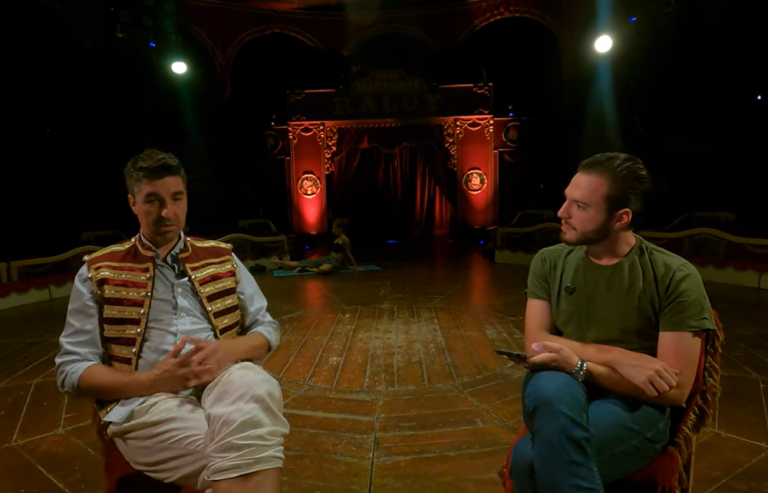
The Raluy Historic Circus continues to bridge the gap between the ring and the digital world. On the YouTube channel of its ringmaster, Aleix Gómez ( RINGMASTR ) , a hilarious and insightful interview with Sandro Roque , one of the most beloved comedians in the current cast, has been published. The video captures the spirit of the classic circus: warmth, rhythm, and skill. And, above all, it offers an honest look at the routines, creative processes, and dilemmas of humor in changing times.
A conversation with skill: humor as a craft
The interview begins with Aleix Gómez's characteristic conspiratorial tone, introducing Sandro with professional admiration. From there, a brisk conversation unfolds in which the Portuguese clown explains how he constructs an act : sometimes by reworking classic routines , other times by distilling everyday moments into gags. The example of the " tutu "—born from a piece of music he found comical—illustrates this blend of intuition, experimentation, and refinement that defines his process.
Roque recalls his family's beginnings in Porto and emphasizes how the pandemic pushed many professionals into " normal " jobs, a phenomenon that, he says, explains some of the current absences on the dance floor. Laughing, he confesses his first appearances on stage— " officially at seven, unofficially at three "—in closing skits, and how childhood shyness coexisted with the fascination of experiencing the dance floor for the first time.
The conversation also touches on artistic influences . Sandro fondly mentions his grandfather—the archetype of the Iberian/Italian august —and names that left their mark, from European clowns with a long tradition to icons of silent film. The underlying message is clear: one's own style is born from observing, absorbing, and refining influences without losing one's essence.
Humor, limits and audience: a living balance
One of the most interesting topics revolves around the limits of humor . Sandro and Aleix agree that audience sensibilities have changed : today there is more information, more comparison… and, at the same time, more polarization. This forces comedians to carefully consider their gestures and references without losing their edge. Roque sums it up pragmatically: “ Humor has no limits; the limits are set by each individual .” At the same time, they argue that the circus isn't just for children . There are shows designed for family audiences and others geared towards adults, and it's sensible to do your research before going , just as you would with any film or concert.
Safety and technology: today's circus versus yesterday's
The talk reviews the technical evolution : protective gear, harnesses, and materials have raised safety standards , something unthinkable decades ago. Artistically, Sandro believes that some ultra-risky stunts are seen less often, but have been replaced by innovative feats that surprise in different ways. The comparison isn't about nostalgia, but about context : the discipline changes, but the demands and the excitement remain.
Tour routine, rituals and small catastrophes
With humor, Roque describes a typical day at the show : checking props, fixing whatever needs fixing, and waiting for the tent to fill up . He's not one for rituals, he admits, beyond a few minor wardrobe quirks. He also acknowledges that improvisation sometimes takes over : a change in the order of the sketch, a signal that arrives late, or a colleague who delivers their line at the wrong time. This controlled " disruption " is part of the charm; the audience rarely notices it, and when they do, they usually celebrate it. There's even room for occupational injuries (bruised fingers and " rehearsed " falls), a reminder that comedy in the circus is written with the body.
The future of the clown: tradition, mix and return
To the question, “ Is a clown born or made? ”, Sandro offers a football analogy: there is innate talent and there is talent developed through practice; both are valuable if they lead to genuine stage presence. Regarding the future of clowning , he is optimistic: the cultural pendulum swings, and aesthetics return with nuances. That is why he advocates for the coexistence of styles —from the traditional painted clown to the more naturalistic character—and even their coexistence within the same show , as was the case in the past with several trios and a comedian performing together.
“For me, the circus is life”
The closing is emotional. Sandro speaks of mud, rain, frozen hoses … and applause . He acknowledges that without pay there is no work, but emphasizes that the audience's gratitude compensates for the effort. If he could start over, he would choose the circus again. He defines it as freedom within discipline : a way of life that allows him to move, create, and reconnect with spectators who remember him fifteen years later. It is, in short, the reason for continuing: to make people laugh and to share.
If you want to experience this energy live, buy your tickets for the Historic Raluy Circus here.